

Introduction
Why SMEs struggle to scale is the focus of this guide — here is what actually works.
Walk into almost any growing SME in Cairo, Riyadh, or Dubai and you’ll find the same story: a founder working sixteen-hour days, a team stretched thin, and revenue that inches up one month and slides back the next. From the outside, it looks like hustle. From the inside, it feels like running on a treadmill that keeps speeding up.
The problem is rarely effort. It’s direction.
Most small and medium enterprises don’t fail because their founders aren’t smart or hardworking enough. They stall because they’re scaling activity — more ads, more hires, more products — without a strategy that tells them which of those moves actually compounds into growth. Strategy isn’t a document that sits in a drawer. It’s the decision-making system that tells a business what to say yes to, what to say no to, and why.
This article breaks down why that gap between effort and strategy causes so many SMEs across Egypt, Saudi Arabia, and the UAE to plateau — and what a working strategic framework actually looks like in practice.

Why SMEs struggle to scale: Why “Growth” and “Strategy” Are Not the Same Thing
Growth is a result. Strategy is the mechanism that produces it deliberately, rather than by accident.
An SME without strategy can still grow — for a while. A founder’s network runs deep, a market is underserved, or a product simply arrives at the right moment. But that kind of growth is fragile. It depends on conditions the founder doesn’t control: word of mouth holding up, no serious competitor entering, the founder personally closing every important deal.
A business with strategy grows because of a repeatable system: a clear position in the market, a defined customer it serves better than anyone else, and a set of priorities that everyone in the company — not just the founder — can execute without asking permission every time. That’s the difference between a business that scales and a business that stays dependent on its founder indefinitely.
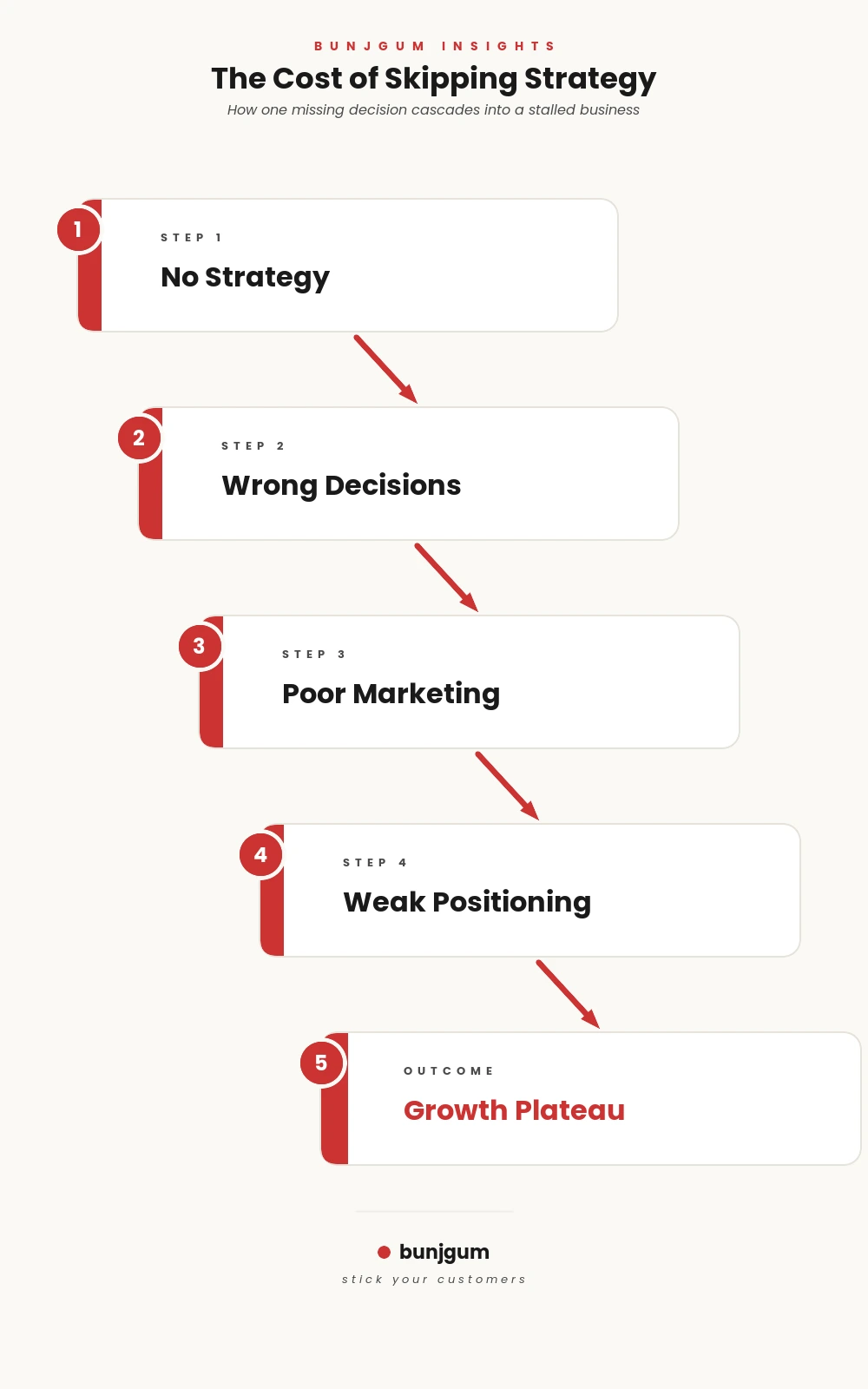
The Five Reasons SMEs Stall Without Strategy
1. They confuse being busy with being strategic.
Every hour is spent reacting — to a client request, a competitor’s move, a cash flow gap — and none is spent deciding what the business should be doing in the first place. Reactive businesses grow in bursts and stall in between.
2. They don’t know who they’re actually competing for.
Without a clear target customer, marketing tries to speak to everyone and convinces no one. Pricing becomes guesswork. Product decisions get made by whoever shouts loudest in the last meeting.
3. They chase every opportunity instead of the right ones.
A new market, a new product line, a new partnership — each one looks promising in isolation. Without strategy as a filter, SMEs say yes to too much, spreading thin resources across initiatives that individually make sense but collectively cancel each other out.
4. The founder becomes the bottleneck.
When there’s no documented strategy, every decision — pricing, hiring, partnerships — routes back through the founder because no one else has the context to decide independently. The business can only grow as fast as one person can personally manage.
5. They have no way to measure whether they’re actually winning.
Without strategic KPIs tied to specific goals, “growth” gets measured by gut feeling. Revenue might be up while margins quietly erode. Customer acquisition might be up while retention falls. Nobody notices until the numbers force a reckoning.
What the Data Says About Planning and Survival
Some of the clearest evidence on this comes from research into business planning and startup survival. Businesses with a formal, documented plan are measurably more likely to survive and to grow faster than those without one, and a large share of failed startups point to poor or missing planning as a root cause of their failure (Bizplanr, 2025).
Execution matters just as much as the plan itself. Research on strategic planning has found that a majority of strategic plans are never fully executed, which is a separate and equally common failure mode — having a strategy on paper but no operating system to carry it out (Entrepreneur, 2024).
In the regional context, the opportunity for SMEs that do get strategy right is significant. In Saudi Arabia, the SME sector’s contribution to GDP has been rising steadily under Vision 2030, with the government targeting 35% of GDP from SMEs by 2030 — up from roughly 20% at the program’s launch (Vision 2030 SME Growth Programme). In the UAE, SMEs already contribute close to 40% of GDP, underscoring how central this sector is to the region’s economic direction (as widely reported in UAE government and industry sources).
We were not able to locate a verified, recent statistic specific to Egyptian SME strategy adoption at the time of writing — so no figure is cited for Egypt here rather than risk an invented number.

Fictional Case Study: Two Bakeries, One Strategy
The following case is a fictional scenario created to illustrate common patterns Bunjgum observes across SMEs in the region. It is not based on a specific real client.
Two bakery chains open within six months of each other in the same Cairo neighborhood. Both have talented founders, similar starting capital, and comparable initial product quality.
Bakery A grows fast in year one — three locations, a wide menu, catering, delivery, wholesale to cafes. The founder says yes to almost every opportunity that appears. By year two, margins have thinned across every line, the flagship location’s quality has slipped because attention is split five ways, and the founder is personally involved in nearly every operational decision.
Bakery B opens one location and deliberately stays there for fourteen months. The founder defines a specific customer — professionals ordering breakfast and light lunch near their offices — and builds the entire operation around serving that customer exceptionally well: a tight menu, consistent quality, fast service at rush hour. Growth is slower to start. But by month eighteen, Bakery B has a defensible reputation, healthy margins, and a documented operating model that a second location can simply replicate.
Three years in, Bakery B has more locations, higher margins, and a founder who can take a two-week vacation without the business missing a beat. Bakery A is still recovering from a decision, eighteen months earlier, to expand into wholesale before its core product was fully stabilized.
The difference wasn’t effort or ambition. It was strategy — a defined customer, a clear filter for opportunities, and the discipline to say no.
Common Mistakes Founders Make When They Skip Strategy
- Treating strategy as a one-time exercise. A strategy written once and never revisited becomes irrelevant within a year as the market shifts.
- Copying a competitor’s playbook instead of building a position. What works for a larger, better-funded competitor rarely translates directly to an SME with different resources and a different customer base.
- Setting goals without setting priorities. “Grow revenue by 30%” is a goal, not a strategy. Strategy specifies how — and just as importantly, what the business will stop doing to make room for it.
- Delegating execution without delegating decision-making authority. Hiring managers but keeping every meaningful decision with the founder defeats the purpose of hiring.
- Ignoring pricing as a strategic lever. Many SMEs treat pricing as an afterthought rather than one of the fastest ways to fix margin and signal market position.
Expert Tips: What a Working Strategy Actually Contains
A strategy that actually gets used — not just written — tends to include four things:
1. A specific target customer, described in enough detail that the team can recognize them and say no to customers outside that definition.
2. A clear point of difference, answering why that specific customer should choose this business over the alternatives available to them.
3. A short list of strategic priorities for the next 12 months — typically no more than three — that every major decision gets tested against.
4. A small set of KPIs tied directly to those priorities, reviewed on a fixed cadence (monthly or quarterly), so the business knows within weeks, not years, whether the strategy is working.
Anything beyond this tends to gather dust. The goal is not a 40-page document — it’s a decision-making tool the team actually uses.
Action Steps: Building Your First Real Strategy in 30 Days
Week 1 — Diagnose. Review the last 12 months honestly: which activities drove real growth, and which just consumed time and cash? Identify where the founder is currently the bottleneck.
Week 2 — Define the customer and the difference. Write down, in one paragraph, exactly who the business serves best and why they choose you. If the honest answer is “anyone who will pay,” that’s the first problem to solve.
Week 3 — Set three priorities and one filter. Choose no more than three strategic priorities for the next 12 months. Write a one-line filter question the team can use to evaluate new opportunities against those priorities.
Week 4 — Build the KPI dashboard and the review cadence. Choose 4–6 KPIs tied to the priorities above. Set a recurring monthly review meeting where those numbers — not gut feeling — determine what happens next.
Key Takeaways
- Growth without strategy is fragile because it depends on conditions the founder can’t control.
- The five most common causes of stalled growth are reactive decision-making, unclear target customers, chasing every opportunity, founder bottlenecks, and the absence of meaningful KPIs.
- Businesses with a documented, actively used plan are measurably more likely to survive and grow — but the plan has to be executed, not just written.
- A working strategy is short: a defined customer, a clear difference, a handful of priorities, and the KPIs that track them.
- The fastest way to start is a focused 30-day diagnostic and planning sprint, not a lengthy annual planning offsite.

FAQ
Why do SMEs struggle to scale even when revenue is growing?
Revenue growth without strategy is often masking shrinking margins, founder dependency, or customer concentration risk. Strategy makes those hidden costs visible before they become existential.
How is strategic planning different from a business plan?
A business plan is typically a static document, often built once for funding or registration purposes. Strategic planning is an ongoing decision-making system that gets revisited and adjusted as the market and the business evolve.
How often should an SME revisit its strategy?
Quarterly reviews of KPIs and priorities, with a deeper annual strategy reset, work well for most SMEs in fast-moving markets like Egypt, Saudi Arabia, and the UAE.
Can a very small business (under 10 employees) benefit from formal strategy?
Yes — arguably more than larger businesses, because a small team has far less capacity to absorb wasted effort on the wrong priorities.
What’s the first sign a business needs to revisit its strategy?
When the founder is the answer to almost every important decision, or when growth in revenue isn’t translating into growth in profit, it’s time to revisit strategy.
Further Reading
- Bizplanr — Business Plan Statistics
- Entrepreneur — Why 67% of Strategic Plans Fail
- Saudi Vision 2030 — SME Growth Priority Programme
That is the core of Why SMEs struggle to scale.
Next Steps
If this sounds like where your business is right now — growing effort without growing clarity — that’s usually the moment a short strategic diagnostic makes the biggest difference. Bunjgum works with founders across Egypt, Saudi Arabia, and the UAE to turn scattered growth into a documented, executable strategy. You can book a consultation, explore our Planning & Strategy services, or reach out directly on WhatsApp if you’d rather just talk it through first.
Related Articles
- How to Build a Winning Business Strategy
- Why Most Business Plans Fail
- How to Build a Business That Runs Without You
Want to apply this in your business?
Our Business Consultation service: we diagnose why your revenue isn’t growing and build the strategy to fix it. Book a free discovery call.

[…] Why SMEs Struggle to Scale Without Strategy […]
[…] Why Most SMEs Struggle to Scale Without a Strategy (2026 Guide) […]
[…] Why Most SMEs Struggle to Scale Without a Strategy (2026 Guide) […]