

Introduction
Marketing is not advertising is the focus of this guide — here is what actually works.
“We tried marketing and it didn’t work” almost always means “we bought ads and they didn’t convert.” That sentence reveals the most expensive misunderstanding in small business growth: treating advertising — a single paid tactic — as if it were the entire discipline of marketing.
Advertising can be an excellent tool. But it’s a tool for amplifying something that already works — a clear positioning, a proven offer, a message that resonates. Buying ads to amplify a weak or unclear offer just means losing money faster and more efficiently.
Marketing vs advertising: What Advertising Actually Is
Advertising is paid media placement: buying attention on a platform — Meta, Google, TikTok, billboards, radio — in exchange for money. It’s a distribution channel, not a strategy. It answers “how do we get this message in front of people,” not “what should the message be” or “why would anyone care.”
What Marketing Actually Includes
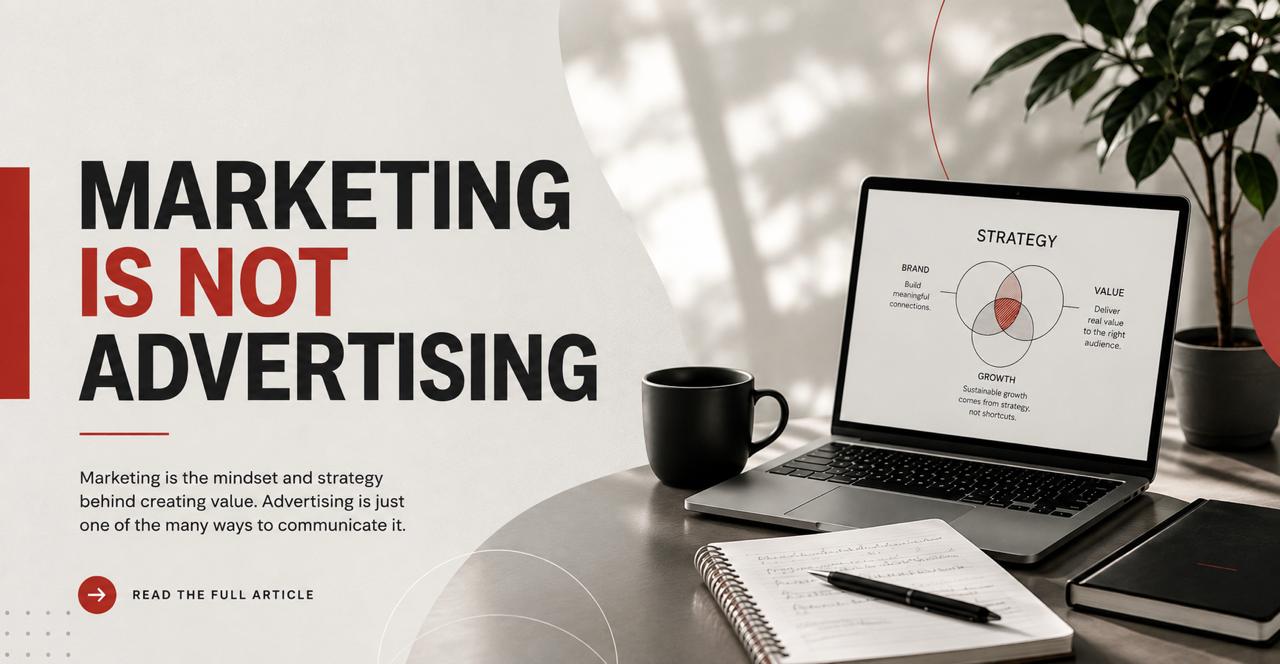
Marketing is the full discipline of understanding a market, positioning a product within it, and building demand — of which advertising is one tactic among many. It includes market research and customer understanding, brand positioning and messaging, pricing as a signal of value, the product experience itself, content and organic channels, and only then, paid distribution to amplify what’s already working.
A useful way to think about it: strategy decides what to say and to whom; advertising is one way (among several) of saying it loudly.
Why This Confusion Costs SMEs Money
When a business skips straight to advertising without doing the positioning and messaging work first, ad spend gets used to test whether an unclear message resonates — an expensive and inefficient way to learn that. Worse, if the underlying offer or positioning is genuinely weak, more ad spend just means losing money faster while learning nothing new. The businesses that get real ROI from advertising almost always did the harder marketing work first: they know exactly who they’re targeting, what makes them different, and what message actually lands — before a single dollar goes to a platform.
Common Mistakes
- Increasing ad budget to fix weak conversion instead of fixing the offer or message first.
- Treating “marketing” and “the ads account” as synonymous in team conversations and budgeting.
- Skipping organic channels and positioning work entirely in favor of paid acquisition.
- Measuring success only by ad platform metrics (clicks, impressions) instead of actual business outcomes.
Key Takeaways
- Advertising is a paid distribution channel; marketing is the full discipline of understanding a market and building demand.
- Ads amplify what already works — they rarely fix a weak or unclear offer.
- Positioning, messaging, and pricing work should come before meaningful ad spend, not after.
- Measuring advertising by business outcomes, not platform metrics, reveals whether it’s actually working.
FAQ
Should a small business skip advertising entirely?
No — advertising can be highly effective, but it works best once positioning, messaging, and offer are already validated through other means.
Why did my ads stop converting even though they used to work?
Often a sign the underlying offer, market, or competitive landscape shifted — advertising performance usually reflects deeper marketing fundamentals, not just ad creative.
What should come before spending on ads?
A clear understanding of the target customer, a differentiated positioning, and a tested core message.
That is the core of Marketing vs advertising.
Next Steps
If ad spend hasn’t translated into growth, the fix is rarely “spend more” — it’s usually the marketing fundamentals underneath. Bunjgum helps businesses across Egypt, Saudi Arabia, and the UAE build marketing strategy before scaling ad spend. Book a consultation or reach out on WhatsApp.
Related Articles
- How to Build a Brand Customers Remember
- Marketing Strategy Frameworks Explained
- Positioning: Why Great Products Still Fail
Want to apply this in your business?
Our Planning & Strategy service: annual marketing plans, go-to-market strategy, pricing architecture and brand positioning, delivered as executive-ready documents. Book a free discovery call.

[…] Marketing Is Not Advertising […]
[…] Marketing Is Not Advertising […]